


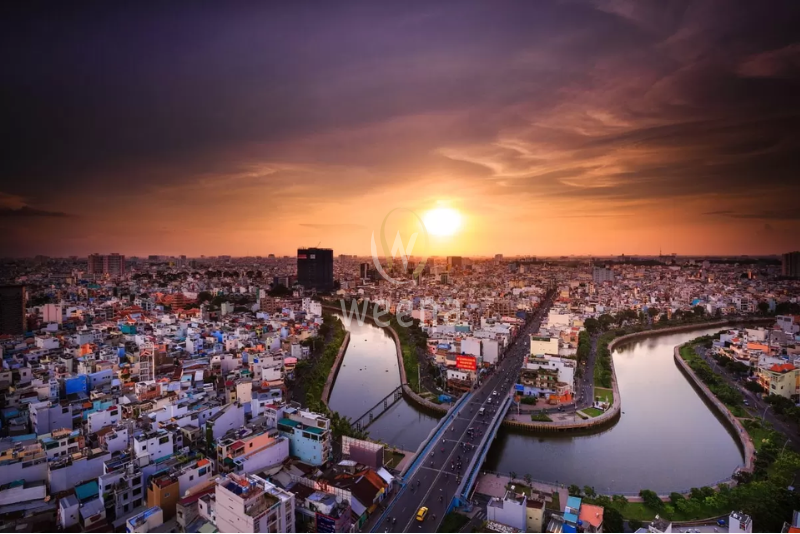

Vietnam’s economic ascent over the past few decades has been nothing short of remarkable, transforming it from one of the world’s poorest nations into a dynamic lower-middle-income economy. As of March 10, 2025, Vietnam stands at a pivotal moment, with its economy poised for continued expansion amid global uncertainties. Fueled by a potent mix of export-led growth, foreign investment, and an adaptable workforce, the country is targeting an ambitious GDP growth rate of at least 8% for 2025, up from 7.09% in 2024. This trajectory not only underscores Vietnam’s resilience but also positions it as a beacon of opportunity in Southeast Asia. Let’s dive into the drivers, challenges, and future prospects of this vibrant economy.
A Legacy of Resilience and Reform
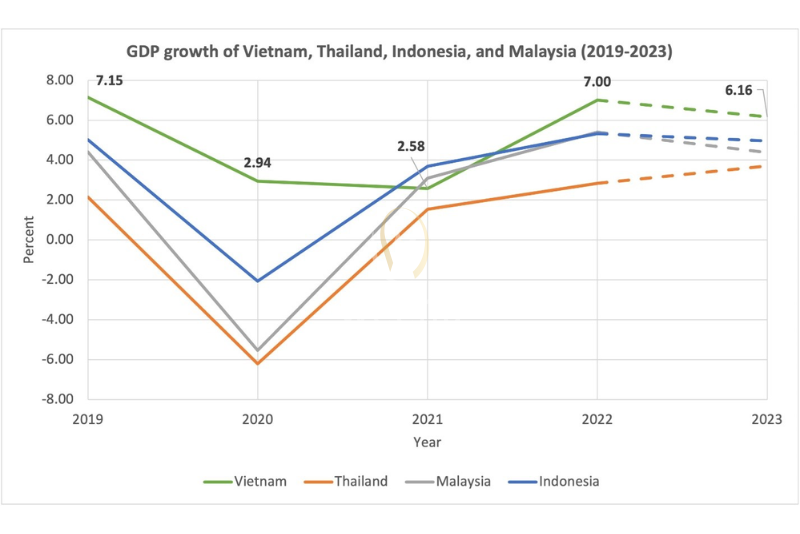
Chart source: rmit.com
Vietnam’s economic story begins with its transition from a centrally planned system to a market-oriented economy, initiated by the Đổi Mới reforms in 1986. These reforms dismantled decades of isolation and stagnation, opening the door to private enterprise and global trade. The results have been staggering: over the past three decades, Vietnam’s GDP growth has averaged 6-7% annually, lifting millions out of poverty. By 2024, the economy reached a nominal GDP of $476.3 billion, a 7.09% increase from the previous year, driven by robust exports and foreign direct investment (FDI). For 2025, the government’s upward revision of its growth target to 8% reflects confidence in sustaining this momentum, even as global trade tensions loom.
The backbone of this growth is Vietnam’s workforce—over 52 million strong, representing more than half of its 100 million population. With a median age of 32, this youthful, industrious labor pool has been a magnet for multinational corporations seeking cost-effective manufacturing hubs. Low unemployment, hovering at 2.24% in Q1 2024, highlights the economy’s ability to absorb its workers, though youth unemployment at 7.99% signals a gap that demands attention. Vietnam’s ability to leverage its human capital while addressing these disparities will be critical to its long-term success.
Engines of Growth: Exports, FDI, and Digital Transformation
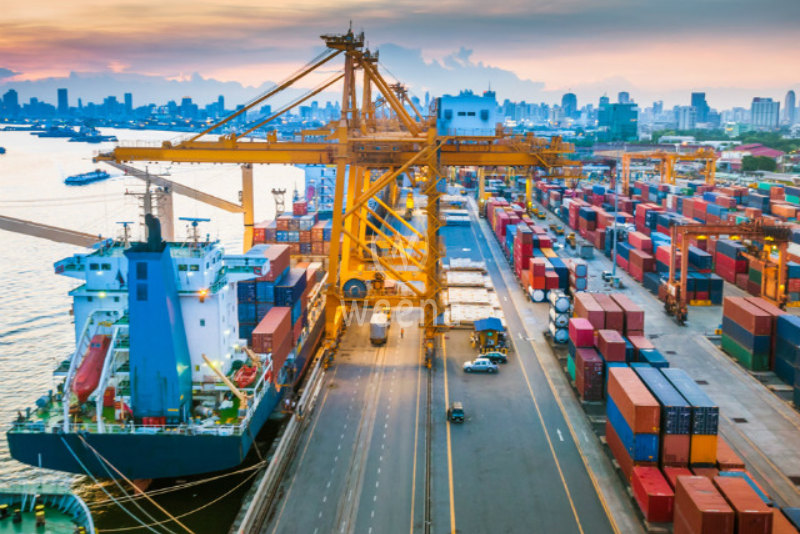
Vietnam’s export sector has been a cornerstone of its economic rise. In 2024, exports grew 14.3% to $405.53 billion, with electronics, textiles, and smartphones leading the charge. The country’s strategic position in global supply chains—bolstered by free trade agreements like the CPTPP and RCEP—has made it a go-to alternative to China amid shifting trade dynamics. For 2025, exports are projected to rise by 12%, contributing to a trade surplus of $30 billion. This export prowess is underpinned by industrial manufacturing, expected to grow 9.5% in 2025, as companies like Samsung and Foxconn deepen their roots in Vietnam.
Foreign direct investment has been equally transformative. In 2024, FDI inflows reached $36.6 billion, a 32.1% jump from the prior year, with $28 billion anticipated for 2025. These funds have fueled industrial hubs, infrastructure projects, and technology adoption, creating jobs and boosting productivity. The government’s proactive policies—such as tax incentives and streamlined regulations—continue to attract investors, even as global uncertainties, like potential U.S. tariffs, cast shadows.
A newer but potent driver is Vietnam’s digital economy. By 2025, this sector is expected to reach $52 billion, propelled by e-commerce, digital banking, and online platforms. The National Digital Transformation Program aims for the digital economy to contribute 25% of GDP by year-end, reflecting Vietnam’s ambition to marry industrial might with technological innovation. This dual transition—digital and green—positions Vietnam as a leader in sustainable growth, with green credit targets set at 10% of total loans by 2025.
Workforce Dynamics: Strength and Challenges
Vietnam’s workforce is both its greatest asset and a focal point for future growth. With over 70% of its population of working age, the country boasts a demographic dividend that many nations envy. Average monthly incomes rose to 7.6 million VND ($305) in Q1 2024, signaling rising living standards and consumer spending power. Low unemployment reflects a labor market that efficiently absorbs workers into manufacturing, services, and agriculture, which still employs 12% of the workforce despite its shrinking GDP share.
Yet, challenges persist. Youth unemployment, at nearly 8%, reveals a mismatch between the skills of young graduates and the demands of a rapidly evolving economy. While industrial jobs abound, the shift toward technology and high-value industries requires upskilling. The government’s investments in education—achieving universal primary enrollment and a learning-adjusted schooling average of 10.2 years—lay a strong foundation, but vocational training and STEM education need scaling to meet future needs. Addressing this gap could unlock even greater economic potential, ensuring that Vietnam’s youth propel it toward high-income status by 2045.
Overcoming Headwinds: Real Estate, Inflation, and Global Risks
Despite its successes, Vietnam’s growth is not without hurdles. The real estate sector, a key economic pillar, has faced liquidity issues and declining asset values, with new condominium supply in Hanoi and Ho Chi Minh City dropping sharply in 2023. Government interventions, like Official Dispatch No. 993/CD-TTg, have spurred recovery by boosting lending and cutting loan rates, but full stabilization remains a work in progress. A robust real estate market is vital for domestic demand, which has lagged behind exports in driving growth.
Inflation, while moderated to 3.5% in 2025 projections, requires vigilance. Rising food prices and global commodity shocks, exacerbated by events like Typhoon Yagi in 2024, could strain household budgets. The State Bank of Vietnam’s accommodative monetary stance—keeping rates at 4.5%—aims to support recovery, but persistent exchange rate pressures could complicate this balance.
Externally, Vietnam’s export dependency exposes it to risks like U.S. trade policy shifts or weakening demand in China. Diversifying markets and bolstering domestic consumption—projected to rise 12% in 2025 via retail sales—are critical countermeasures. Infrastructure gaps, from energy to logistics, also loom large, though ambitious projects like Long Thanh International Airport signal intent to close them.
The Road Ahead: A Vision for 2045
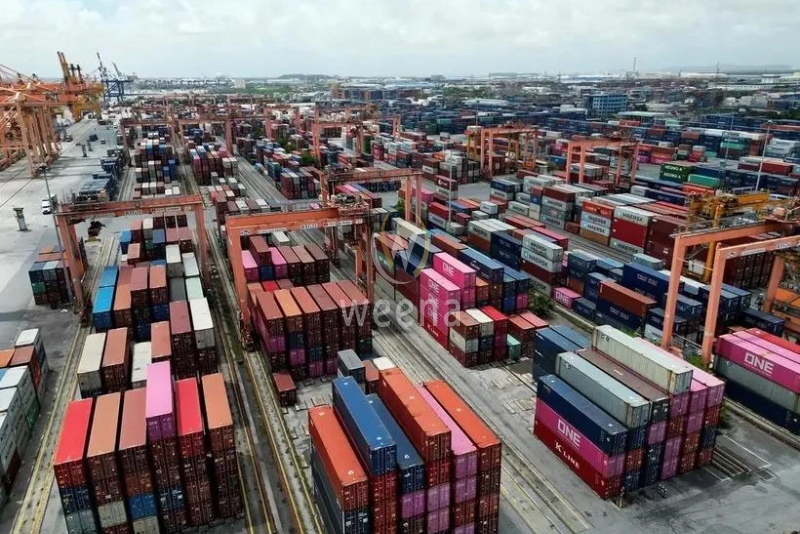
Vietnam’s economic vision is bold: upper-middle-income status by 2030 and high-income status by 2045, with a GDP exceeding $1 trillion. Achieving this requires sustaining 7.5-8.5% annual growth through 2030, a feat within reach if current trends hold. Industrial modernization, export diversification, and green initiatives—like a 30.9-39.2% renewable energy mix by 2030—will be key. So too will capital market development, with stock market capitalization targeted at 100% of GDP by 2025.
For professionals and investors, Vietnam offers a compelling narrative: a youthful workforce, low unemployment, and a government committed to growth. Yet, success hinges on navigating uneven recovery, upskilling youth, and mitigating external risks. As Vietnam strides toward its 2045 goal, its journey exemplifies resilience, adaptability, and ambition—a model for emerging economies worldwide. What’s your perspective on this economic powerhouse in the making?
For further questions, please contact us through:
Weena Trading Asia Investment Company,
Address: No. 15, Lane 1, An Duong Vuong Street, Phu Thuong Ward, Tay Ho, Hanoi
Email: info@weena.vn
Phone: 092 591 3986
No Comments